How to Remember Every Difficult State Capital: Tricks That Actually Stick
Most people try to learn the 50 state capitals by reading a list from top to bottom, and most people fail at exactly the same places: New York, California, Nevada, Florida, South Carolina and Kansas. The list method fails because it fights the brain’s strongest habit, which is to answer with the biggest, most famous city in a state. A better method replaces that habit with a small set of rules and hooks, so that when the famous city pops into your head, you already know whether to trust it or to overrule it. This post gives you those rules, one at a time, with the exact examples that make each rule stick, so that the next time a quiz asks for a capital, you have a system instead of a guess.
Play the US States Capitals Quiz
Rule 1: Learn the 17 Yeses First
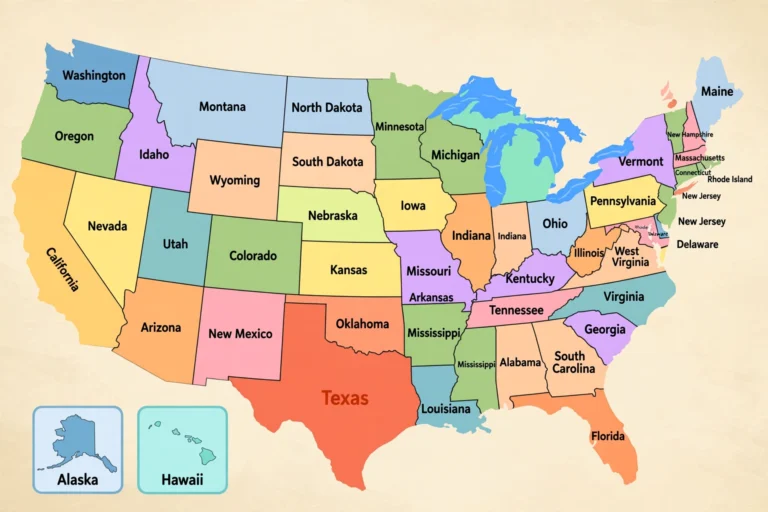
Start with the 17 capitals that are also the largest city in their state: Phoenix, Little Rock, Denver, Atlanta, Honolulu, Boise, Indianapolis, Des Moines, Boston, Jackson, Columbus, Oklahoma City, Providence, Nashville, Salt Lake City, Charleston in West Virginia, and Cheyenne. Learn those 17 cold, because they change how you answer everything else. If a question asks for the capital of a state and the famous city in your head is not one of those 17, it is probably a trap. New York City is not on the list, so Albany must be the answer. Los Angeles is not on the list, so Sacramento must be. Las Vegas is not on the list, so Carson City must be. Elimination is faster than recall, and it works even when you cannot remember the capital directly, which is exactly the situation a timed quiz puts you in. Drill the 17 until they feel obvious, then the remaining 33 states become a smaller, more manageable problem.
The 17 also contain two useful surprises that teach the rule by themselves. Nashville is both the capital and the largest city of Tennessee, which surprises learners who expect Memphis, the music-famous city, to be larger. Charleston in West Virginia is both the capital and the largest city of its state, which surprises learners who know Charleston in South Carolina better. Both surprises reward the same habit: check the list of 17 before you trust fame. If you only remember one number from this post, remember 17 out of 50, because that single number tells you that the famous-city answer is wrong most of the time.
Rule 2: Use Superlatives as Anchors
Superlatives are the easiest facts to remember because they have no competition. The smallest capital is Montpelier, Vermont, with about 7,800 people, and once you know that, no question about the smallest capital can catch you. The largest capital is Phoenix, Arizona, with about 1.67 million people, and that fact alone answers two questions at once: the largest capital, and the capital of Arizona. The second-largest capital is Austin, Texas, with about a million people, but Austin is only fifth in Texas, behind Houston, San Antonio, Dallas and Fort Worth, which makes it a perfect trap question in reverse: a huge capital that is still not its state’s largest city. The lowest-ranking capital is Olympia, Washington, at 24th in its own state, while Seattle dominates attention. Anchor these four superlatives in your memory, and they become landmarks you can navigate from, rather than isolated facts you have to retrieve cold.
Superlatives also help with the small capitals that cluster together. Only four capitals have fewer than 30,000 people: Montpelier, Pierre, Augusta in Maine, and Frankfort. If a question feels like it must have a tiny answer, it is almost certainly one of those four, and the state in the question will tell you which one. Pierre is the South Dakota answer, Augusta the Maine answer, Frankfort the Kentucky answer, and Montpelier the Vermont answer. Grouping by size turns four separate facts into one pattern, and patterns survive under time pressure far better than lists do.
Rule 3: Drill Same-Name Pairs Together
Same-name pairs are the quiz writer’s favourite weapon, because a lone fact gives you no way to tell them apart, while a pair gives you a contrast that sticks. Charleston in West Virginia is a capital and its state’s largest city; Charleston in South Carolina is its state’s largest city but not its capital, because Columbia is. Columbia in South Carolina is a capital; Columbus in Ohio is a capital and its state’s largest city, and the spelling difference is one letter group, Columbia against Columbus. Portland is the largest city in both Maine and Oregon, and neither Portland is a capital: Augusta is the capital of Maine, Salem is the capital of Oregon, and the Oregon city was named after the Maine city. Kansas City is the hardest pair of all, because there are two of them and neither is a capital: Kansas City, Missouri, is Missouri’s largest city, Kansas City, Kansas, is a separate smaller city across the state line, and Topeka is the capital of Kansas. Always require the state with the city name, and the pair will stop fooling you.
The trick with pairs is to practise them as questions, not as notes. Ask yourself: Charleston, which state? Columbia or Columbus, which spelling? Portland, which coast? Kansas City, which side of the line? Each question forces the contrast into memory, while reading a note about the pair lets your eyes slide past it. The capitals quiz on this site is built for exactly that kind of drilling, with a Learn deck for the pairs and rounds that ask the same trap from both directions, so that you meet Charleston in West Virginia and Charleston in South Carolina in the same session and learn to ask which state before you answer.
Rule 4: Say the Hard Names Out Loud
Pronunciation is a memory anchor that reading alone cannot give you, because a name you have never said feels less real than a name you have. Pierre in South Dakota is said like the word peer, not pee-air, and saying it correctly once makes the French spelling stop misleading you. Helena in Montana is HEL-en-uh, not hel-EE-nuh, and the ballerina joke is actually useful: Helena is not a ballerina, she is a governor’s city. Boise in Idaho is BOY-see, not BOY-zee, and Des Moines in Iowa is duh-MOIN, with a silent final s. Baton Rouge in Louisiana is BAT-uhn ROOZH, and Juneau in Alaska is JOO-noh, with the stress on the first syllable. Say each of these out loud three times, and the sound becomes a hook that the spelling alone never gave you.
Pronunciation also warns you about the trap cities that are not capitals. Louisville in Kentucky is said LOO-uh-vull by locals, not LOO-ee-ville, and it is the largest city in Kentucky, not the capital: Frankfort is. That distinction matters because a quiz that asks for Kentucky’s capital is really asking whether you can overrule the most famous city in the state, and the local pronunciation is a reminder that Louisville belongs to Kentucky’s culture, not its government. The same logic applies to every famous city in this post: fame is about culture and commerce, and capitals are about government, and keeping those two ideas separate is the whole skill.
Rule 5: Remember Why Capitals Were Chosen
The deepest trick is not a mnemonic at all, but an understanding of why the map looks the way it does. Capitals were generally chosen for centrality and political neutrality, often before the famous city grew, and several were purpose-built, including Tallahassee, Raleigh, Columbus and Indianapolis. That is why Sacramento beats Los Angeles, Albany beats New York City, Springfield beats Chicago, and Harrisburg beats Philadelphia: the government went where it could govern from, not where the crowds already were. Once you believe that story, the famous-city answer stops feeling like common sense and starts feeling like the trap it is. You will still get caught sometimes, because fame is a strong habit, but you will catch yourself more often, and catching yourself is the skill that turns a middling quiz score into a high one.
Finally, learn the names, not just the rankings. Largest-city rankings change: Huntsville has overtaken Birmingham in Alabama, Nashville has overtaken Memphis in Tennessee, and Charleston has overtaken Columbia in South Carolina, all on the latest Census Bureau estimates. If you learn only that Birmingham is Alabama’s largest city, you will be confidently wrong. If you learn the rule, the pairs and the superlatives, a ranking change is just a new example of an old pattern. Play the quiz, use the Learn cards for the ones that catch you, and come back to these five rules whenever your score stalls. The capitals do not change, but your system for remembering them can, and that is the whole game.
Is there a trick to remember all 50 capitals, or do I just have to memorise them?
There is a system, not a single trick: learn the 17 capitals that are also the largest city, use superlatives as anchors, drill same-name pairs, and say the hard names out loud.
How do I stop mixing up Columbia and Columbus?
Columbia, with an A, is the capital of South Carolina. Columbus, with a US, is the capital of Ohio and its largest city.
How do I remember Kansas City, Missouri vs Kansas City, Kansas vs Topeka?
Neither Kansas City is a capital. Kansas City, Missouri, is Missouri’s largest city, Kansas City, Kansas, is a separate smaller city, and Topeka is the capital of Kansas.
Which pronunciations will give me away as a non-local?
Pierre as pee-air instead of peer, Helena as hel-EE-nuh instead of HEL-en-uh, Boise as BOY-zee instead of BOY-see, and Des Moines with a sounded final s instead of duh-MOIN.
How often do largest-city rankings change?
They change slowly, but they do change: Huntsville, Nashville and Charleston have all overtaken older answers on the latest Census Bureau estimates, so learn the names from a current list, not an old textbook.
Now put the five rules to the test in the capitals quiz, and keep the Learn cards open for the traps that still catch you. For the full map game, head back to the us states quiz home page and keep playing.