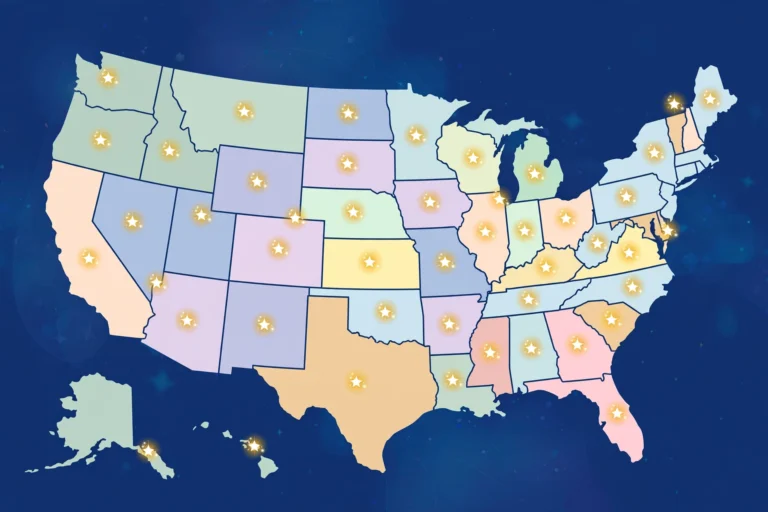
The 13 originals first, then the rush west: how America grew to 50
America did not become fifty states all at once. It grew in waves — a burst of thirteen, a long steady march west, a sudden rush of four states in ten days, and then a silence of forty-seven years before the final two arrived. If you have ever stared at a list of admission dates and felt them blur together, it is because lists hide the waves. Learn the waves, and the fifty dates stop being fifty separate facts and start being one story you can retell. This post tells that story, wave by wave, and shows how each wave makes the next one easier to remember.
Play the US States Statehood Order Quiz
Wave one: the thirteen originals (1787–1790)
The story starts with ratification, not revolution. Delaware led on December 7, 1787, becoming the First State by being the first to ratify the new Constitution, and twelve more followed within three years: Pennsylvania, New Jersey, Georgia, Connecticut, Massachusetts, Maryland, South Carolina, New Hampshire, Virginia, New York, North Carolina, and finally Rhode Island in May 1790. These thirteen are the original states, and their order is the order of a political argument being won, state by state, not the order of a map.
For memory, the trick is that the first three — Delaware, Pennsylvania, New Jersey — all ratified within eleven days of each other in December 1787. After that the pace slows, and Rhode Island’s lateness becomes the memorable exception: the last original, holding out for over two years after Delaware. Learn “Delaware first, Rhode Island last of the thirteen” and the whole wave has handles at both ends.
Wave two: the early republic (1791–1821)
Once the original thirteen were set, America started adding neighbours and frontiers. Vermont joined in 1791 and Kentucky in 1792, then Tennessee in 1796, Ohio in 1803, Louisiana in 1812, Indiana in 1816, Mississippi in 1817, Illinois in 1818, Alabama in 1819, Maine in 1820, and Missouri in 1821. Notice the rhythm: roughly one state every few years, moving west and south as settlement spread.
Two of these deserve special attention because quizzes love them. Ohio (1803) is the first state admitted from the old Northwest Territory, and it opens the westward story. Maine (1820) is the quiet one — a northern state carved out of Massachusetts, admitted the same year as the Missouri Compromise debates that shaped the next forty years. Neither fact is required to play the quiz, but both give the dates something to hang onto, and hanging facts beat floating ones every time.
Wave three: westward growth (1836–1876)
After Missouri in 1821, the story pauses for fifteen years — and then the westward wave begins. Arkansas in 1836, Michigan in 1837, Florida and Texas in 1845, Iowa in 1846, Wisconsin in 1848, California in 1850, Minnesota in 1858, Oregon in 1859, Kansas in 1861, West Virginia in 1863, Nevada in 1864, Nebraska in 1867, and Colorado in 1876. This is the longest wave and the messiest, because it spans the age of expansion, the Civil War, and the first transcontinental era.
The anchors here are the ones quizzes return to again and again. Texas (1845) and California (1850) are the famous pair of the wave, but they are five years apart, not neighbours in time. West Virginia (1863) is the Civil War exception, a state born by splitting from Virginia during the war itself. Colorado (1876) is the centenary state, admitted in America’s hundredth year, and it closes the wave with a date that explains itself.
Wave four: the rush, the pair, and the silence (1889–1959)
Then comes the sprint. In 1889 alone, four states joined: North Dakota and South Dakota on the same day (November 2), Montana on November 8, and Washington on November 11 — four states in ten days. Idaho and Wyoming followed in 1890, Utah in 1896, Oklahoma in 1907, and New Mexico and Arizona in 1912, five weeks apart. And then, silence. For forty-seven years, no state joined at all, until Alaska in January 1959 and Hawaii in August 1959 completed the fifty.
That silence is the most memorable fact in the whole timeline, because it breaks the pattern so completely. Every other gap in the story lasts a few years; this one lasts nearly half a century. When a quiz round contains a 1912 state and a 1959 state, the gap is the question: nothing happened between them, and knowing that is worth more than knowing either exact date.
Frequently asked questions
Why did so many states join in 1889?
The northern plains territories had grown enough in population and organisation to seek statehood together, and Congress admitted them in a cluster, starting with the two Dakotas on the same day.
Which wave is hardest to learn?
Usually the westward wave of 1836–1876, because it holds fourteen states across forty years. The anchors — Texas, California, West Virginia, Colorado — divide it into manageable pieces.
Is Delaware really the first state?
Yes, by ratification: Delaware ratified the Constitution first, on December 7, 1787, which is why it is called the First State.
How long did it take to reach fifty states?
From Delaware in 1787 to Hawaii in 1959 is 172 years — nearly two centuries of growth, with the longest single silence lasting 47 years at the end.
Thirteen originals, a steady republic, a westward wave, a ten-day rush, and a forty-seven-year silence before the final two. That is the whole story of how America grew to fifty, and it is far easier to carry than fifty separate dates. Learn the waves, anchor the landmarks, and the order builds itself. Test the story against the clock with more geography rounds on us states quiz, and see how much of the timeline you can rebuild from memory alone.