State Name Length and Letter Patterns: Wordplay Tricks for Vowel Quizzes
When the consonants disappear and only vowels remain, two things still give the state away: how long the name is, and which letters sit at the edges. Players who learn to read those two clues stop guessing and start solving. This is the wordplay side of the game where you guess the state from vowels only, and it is the side most players never practice.
SHORT NAMES, SHORT PATTERNS
Short state names leave short patterns, and short patterns are either instant or impossible. There is no middle ground, because there is almost nothing to reason with.
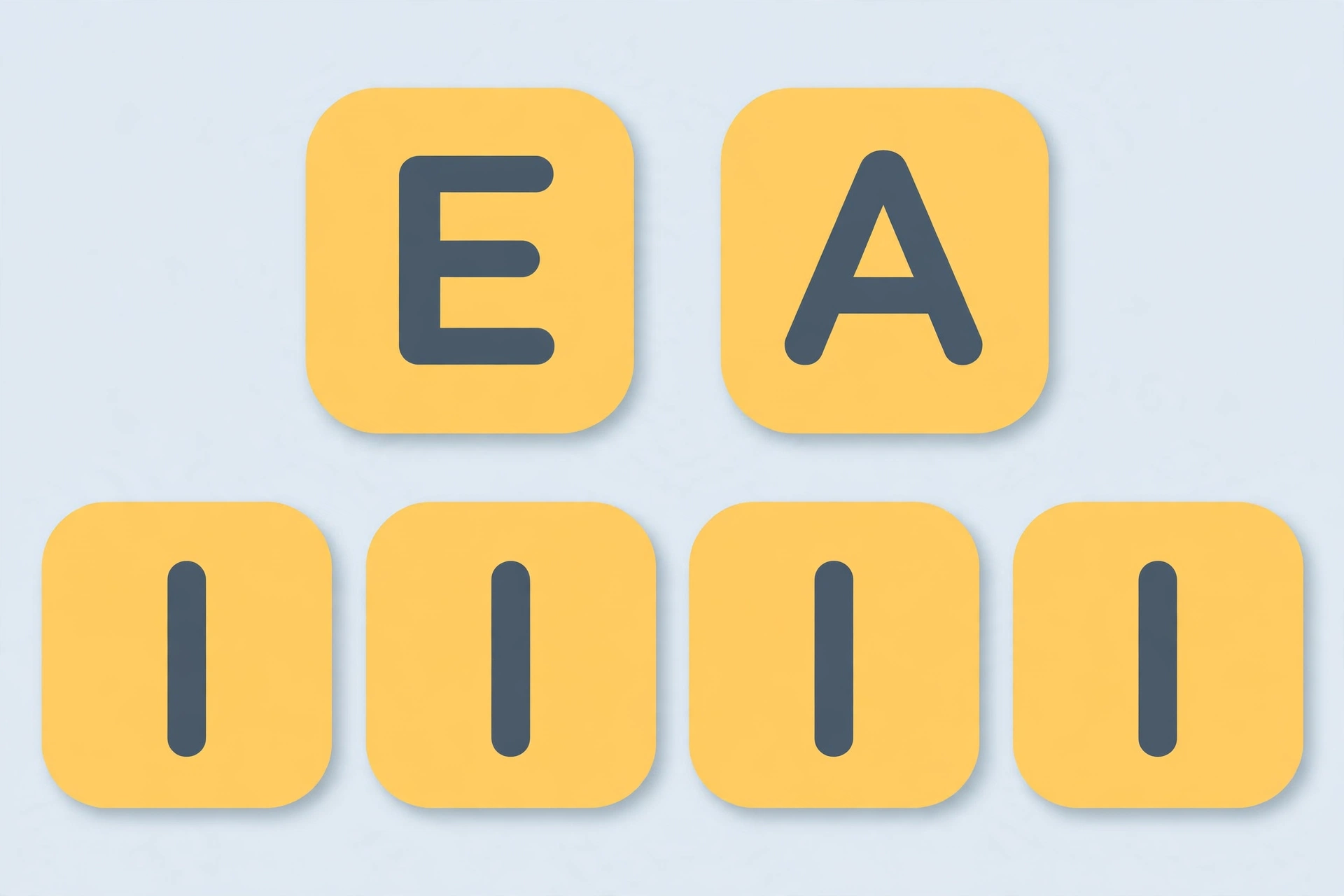
Texas: E A. Two vowels, and that is the whole clue. Either E A already means Texas in your head, or you are guessing between the short names. The fix is boring but real: learn short patterns as facts, the same way you learn a phone number. Once E A means Texas, it means Texas forever.
Ohio: O I O. Iowa: I O A. Three tiles each, and they look alike on purpose. This is where first and last letters earn their keep: Ohio starts and ends with O, while Iowa starts with I and ends with A. Read the edges first, and the pair stops being a trap.
Maine: A I E. Another short one, and another reason to memorize rather than reason. Short patterns do not give you enough material to work out the answer, so they must be known cold before the round starts.
LONG NAMES, LONG PATTERNS
Long names are kinder, because a long pattern carries more information. The trick is to count instead of panic.
Mississippi: I I I I. Four identical vowels in a row. The repetition is the clue. When you see four of the same tile, slow down and count before you pick.
Massachusetts: A A U E. Connecticut: O E I U. These are consonant-heavy names, so their vowel patterns look thin compared to their length. That thinness is itself useful: a long name with only four vowels narrows the field fast. Once you have memorized A A U E and O E I U, length stops mattering for these two.
South Dakota: O U A O A. Five vowels, and the U near the front is the giveaway. Compare it with the shared O A O A pattern of North Dakota and Oklahoma: one extra vowel in second place changes everything. Near-miss patterns like this are where careful reading beats fast guessing.
Alabama: A A A A. Four As, and it sits right next to the shared A A A of Alaska and Arkansas. One more A is the whole difference. When two patterns differ by a single tile, counting is not optional, it is the entire skill.
LEARN FAMILIES, NOT JUST SINGLES
The fastest shortcut in this game is to learn states in families, because families share habits. Once you know a family, every member gets easier.
- The New states: New Hampshire, New Jersey, New Mexico, and New York. Read the first word carefully before you answer, because the shared opening is what makes them confusing.
- The North and South states: North Carolina and South Carolina, North Dakota and South Dakota. The direction word is part of the name, so it is part of the pattern you must remember.
- The Carolinas and the Dakotas: two pairs that behave like mirror images. Learn each pair as one unit, then learn what splits them apart.
- Virginia and West Virginia: West Virginia contains the full Virginia pattern inside a longer name. The extra word is the clue, not the confusion, once you expect it.
Families also explain the five shared patterns. Kansas and Maryland share A A, Alaska and Arkansas share A A A, Nebraska and Nevada share E A A, New York and Vermont share E O, and North Dakota and Oklahoma share O A O A. None of these pairs ever appear together as options, so every round still has exactly one correct answer.
FIRST AND LAST LETTERS SETTLE EVERYTHING
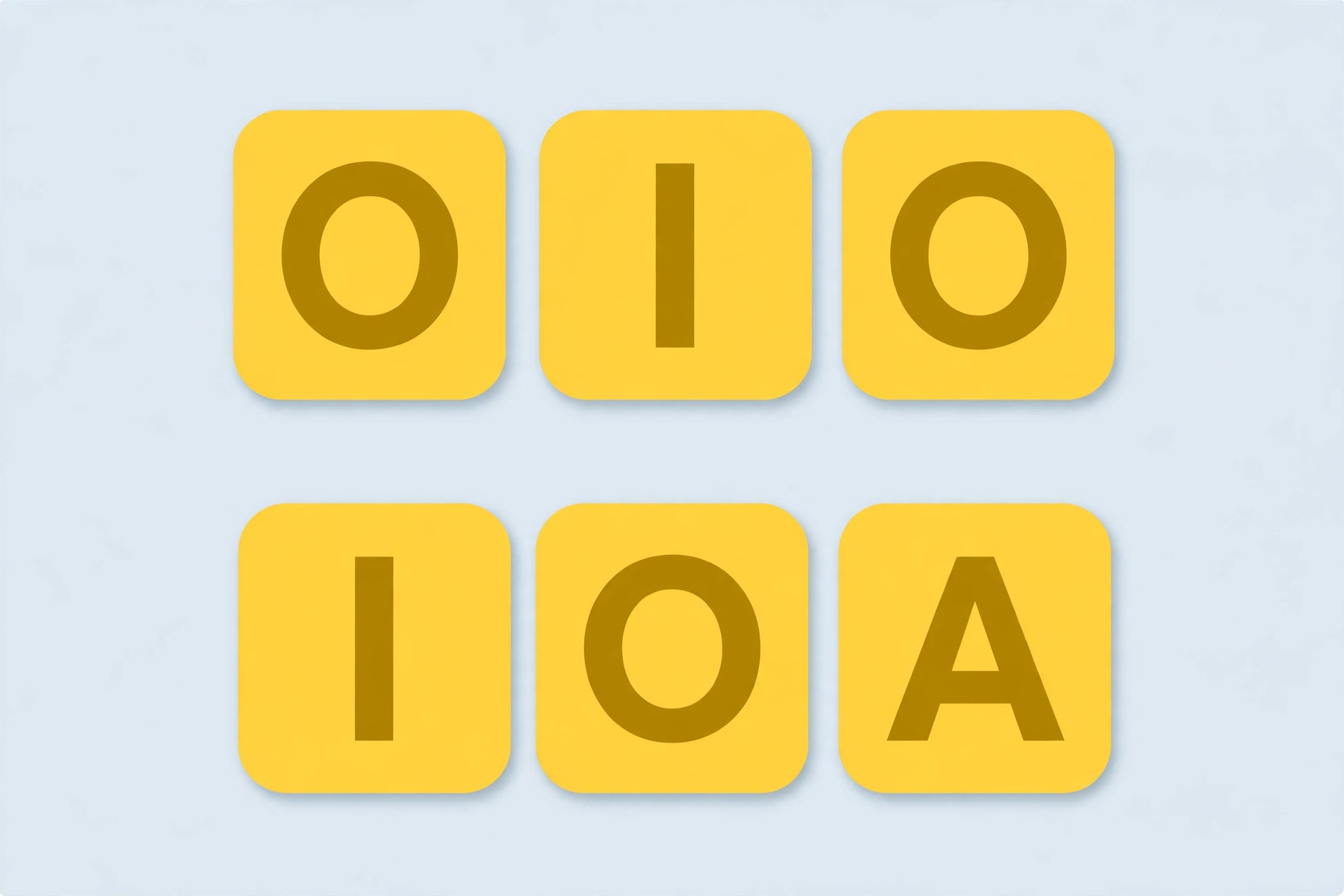
When two patterns look alike, do not stare at the middle. Look at the edges. Ohio vs Iowa is decided by the first and last tiles. Alabama vs Alaska and Arkansas is decided by counting to four instead of three. South Dakota vs North Dakota is decided by the U in second place.
This is the single most useful habit in the game: edges first, middle second, count always. Spelling beats sound, so trust the letters you see over the name you hear in your head.
A SIMPLE PRACTICE PLAN
Wordplay skill comes from short, repeated practice, not from one long session. Short sessions across a week beat one long session, because each return forces you to recall patterns from scratch, and that effort turns a pattern you recognized once into a pattern you know.
- Learn before you play. Go through the Learn cards first, even if you already know the states. Seeing each pattern once makes quiz rounds feel familiar.
- Say the pattern out loud. When you see A I O I A, read the vowels slowly. Hearing the sounds helps your brain connect the pattern to the name.
- Memorize the five shared pairs. They are the only patterns that belong to two states, so they are the only ones you must learn as pairs.
- Start on Easy and move up. Easy uses 15 rounds with the most famous states. Move to Medium at 30 rounds, then Hard at 50 states, only when you finish rounds with lives left.
- Loop back for misses. A few cards, then a short Easy round, then back to Learn for the states you missed. That loop is the whole method.
Learn mode itself helps here: 50 cards, no timer, no score, one state at a time. And Classroom mode lets you search any state by name, capital, or abbreviation and see its blanked tiles plus a hint with its letter count and first letters.
FREQUENTLY ASKED QUESTIONS
Does state name length really help? Yes. Short patterns must be memorized because there is nothing to reason with, while long patterns give you more tiles to count and compare.
Which vowel pattern is the hardest? The shortest ones, like E A for Texas, because two tiles leave no room to work out the answer. Memorize short patterns as facts.
How do I stop mixing up Ohio and Iowa? Read the edges first. Ohio starts and ends with O, while Iowa starts with I and ends with A.
Why do the Dakotas and Carolinas confuse everyone? They share family words like North, South, and Dakota, so learn each pair as one unit first, then learn what splits the two members apart.
How much should I practice each day? A short session beats a long one. A few Learn cards plus one short Easy round a day, spread across a week, builds stronger memory than one long session.
Length, edges, families, and counting: those four clues cover nearly every round this game can throw at you. For more quizzes, head back to the “us states quiz” homepage and keep playing.